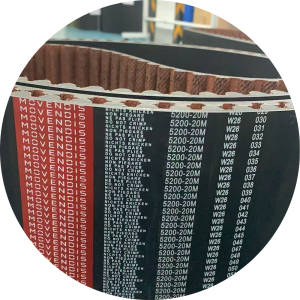
In rubber timing belts, performance differences are rarely visible on day one. Most belts appear similar when new.
The real distinctions emerge over time, through noise levels, rubber dust generation, unstable friction, progressive wear, and ultimately overall system reliability.
One of the most critical yet underestimated factors influencing long-term performance in timing belts is the fabric–rubber interface at the tooth level.
The Hidden Weak Point in Low-Cost Timing Belts
Many low-end rubber timing belts are engineered primarily for cost reduction. At the tooth interface, this often results in:
- Simplified or inconsistent adhesion systems
- Basic tooth fabrics with limited wear resistance
- Reduced curing and vulcanization process control
These compromises rarely cause immediate failure. Instead, they lead to progressive degradation such as:
- Rubber bleeding through the fabric weave
- Micro-delamination under cyclic loads
- Increased rubber dust and contamination
- Rising noise and unstable friction behavior
For users, this means higher maintenance frequency, reduced cleanliness, and unpredictable belt life.
What Is RFL in Rubber Timing Belts?
RFL (Resorcinol–Formaldehyde–Latex) is often misunderstood in the context of rubber timing belts.
RFL is not a fabric!
It is an adhesion system designed to create a durable bond between the tooth fabric and the rubber compound during vulcanization.
In high-quality timing belts, RFL plays a critical role in stabilizing the interface under:
- Elevated temperatures
- Repeated flexing
- Cyclic mechanical loads
- Long operating hours
At Movendis, RFL-treated tooth fabrics are used as a technical baseline across our rubber timing belts. This ensures consistent adhesion performance and differentiates our belts from low-cost alternatives where adhesion quality may be inconsistent.
Importantly, RFL alone does not make a belt “clean type.”
However, without robust RFL-based adhesion, clean operation cannot be maintained over time.
What Does “Clean Type” Mean?
In rubber timing belts, clean type does not refer to a surface coating or cosmetic treatment.
It describes operational behavior:
- Reduced rubber dust generation
- Controlled friction during tooth engagement
- Lower noise and vibration
- Progressive and predictable wear
A true clean type timing belt requires precise control of three technical elements:
Fabric Architecture
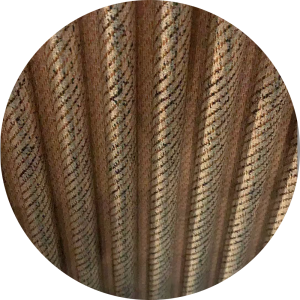
A dense, woven polyamide (nylon) tooth fabric with controlled surface structure to minimize abrasion and debris formation.
Adhesion System
Properly formulated and cured RFL ensures long-term bond stability between fabric and rubber compound.
Optimized Rubber Compound
EPDM, HNBR, or CR compounds engineered for abrasion resistance, thermal stability, and fabric compatibility.
When these elements are correctly balanced, the fabric remains intact and visible without rubber bleeding through the weave. This is a clear indicator of genuine clean type performance.
When is "Clean Type" Really Necessary?
Not all applications require clean type rubber timing belts.
They become technically justified when:
- Rubber dust or contamination must be minimized
- Maintenance access is limited
- Noise and vibration control are critical
- Systems operate continuously at stable load and speed
In standard industrial applications, rubber timing belts with robust RFL-based adhesion already provide reliable, predictable performance without unnecessary complexity.
Therefore, clean type should be an application-driven engineering decision, not a generic marketing label.
Engineering Focus: Performance Over Claims
Movendis’ approach to rubber timing belts combines:
- Standardized RFL-based adhesion systems
- Controlled vulcanization processes
- Clean type solutions when technically justified
- Application-specific material selection
The result is predictable long-term behavior instead of short-term visual similarity.
Remeber: what truly matters is not how they look on day one, but how the fabric–rubber interface performs after millions of cycles.